
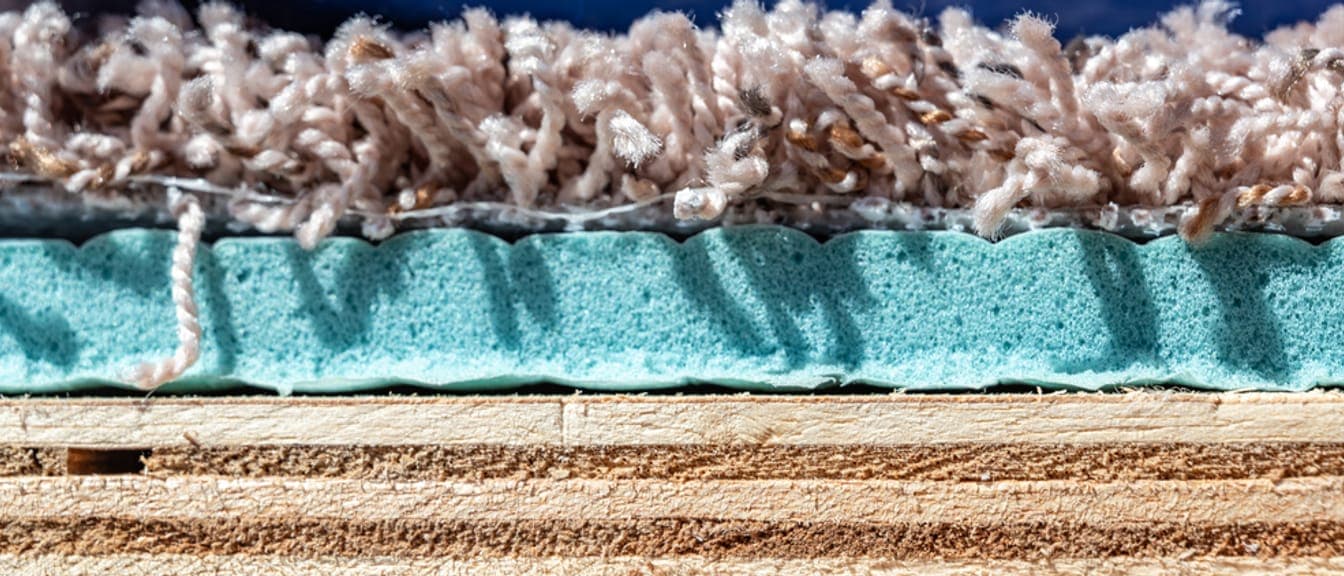
Carpet is good at keeping secrets. When water gets into it, the layer you can see and touch recovers first and complains least, while the real events run their course two inches down, out of sight. That gap between what the floor shows and what the floor is doing is why wet carpet decisions go wrong so often, and why the same spill can be a minor errand on Monday and a flooring project by Thursday.
So here is the tour nobody gets to take: the four layers under your feet, and what each one is doing at hour one, day one, and day three.
Meet the stack
From the top down. The pile is the face fiber, usually nylon or polyester, and it is the most water-tolerant part of the whole assembly. It dries quickly, resists most microbial growth on its own, and reports almost nothing about conditions below it.
Under the pile is the backing: two woven layers bonded together with latex adhesive. The latex is what holds the carpet together as a single object, and it is the layer with the least patience for staying wet.
Under that sits the pad, almost always open-cell foam, chosen for softness underfoot. Open-cell means connected pockets, which makes the pad an excellent sponge. It absorbs many times its own weight in water, holds it in the dark, and releases it slowly. That is a great quality in a bath towel and a terrible one in a floor. Whatever share of the spill you did not towel up is mostly in here.
At the bottom is the subfloor, usually OSB or plywood over joists, sometimes a concrete slab. Wood subfloors absorb water and swell. Slabs absorb little but keep the underside of the pad cold and damp, which slows everything above them.
Hour one: gravity and wicking
In the first hour the story is movement. Water passes through the pile and backing in minutes and reaches the pad, and the pad starts doing what sponges do, pulling water sideways well past the edge of the visible spill. The wet area you can see is a poor map of the wet area you have, usually by a factor of two or three. Water also follows the subfloor along its low spots, which is how a laundry room leak turns up under the hallway carpet.
Nothing is damaged yet. At hour one this is a wet floor, and a wet floor that gets real extraction the same day usually dries without a single lasting mark. That is the entire argument for treating the first day with urgency, and it is why the save-or-replace question is mostly a question about time.
The end of day one: saturation
By the twenty-four hour mark the pad has stopped absorbing and started holding. It is saturated, pressed between the backing above and the subfloor below, with no airflow reaching it from either side. The latex in the backing has been soaking all day and is beginning to soften. Wood is joining in: a plywood or OSB subfloor has been drinking from the pad for a full day, tack strips along the walls are rusting, and baseboards are wicking water upward.
The surface, meanwhile, may feel nearly dry, especially if fans have been running. Day one is when the floor starts lying to you. The damage below is still mostly recoverable, but the margin is being spent hour by hour.
Day three: the receipt arrives
Around the third day, two lines get crossed. The first is structural. Latex that has been wet this long starts to let go, and when the backing layers separate, called delamination, the carpet stops being one object. A delaminated carpet ripples, creases, and cannot be re-stretched back to health. No amount of drying reverses it, because the failure is glue, and the glue is gone.
The second line is biological. Damp, dark, still, and room temperature is a culture recipe, and by day three the culture is established and metabolizing. The musty smell that shows up around now is the receipt for that: microbial activity announcing itself through the pile. Our page on musty carpet smell after water covers what that odor means and what can still be done about it. A pad that has spent three days saturated is also, in most cases, no longer a candidate for saving. It can be extracted and dried, but a long-soaked pad usually needs to come out, and replacing pad is not something we do, so you will hear that from us plainly at the walkthrough instead of after the invoice.
This is why day three is a different decision than hour three. At hour three the question is how fast the water can come out. At day three the question is what is still worth drying, and the honest answer sometimes includes a demolition contractor and a carpet installer, neither of which is us. Past roughly 48 hours of standing water, or with water from a contaminated source, the whole job belongs to a full-scale restoration outfit, and no fan, wet-vac, or Safe-Dry crew changes that.
The layer nobody thinks about
One postscript on the bottom of the stack. Even after carpet and pad are handled, a wood subfloor that took water needs its own dry-down, because swollen OSB edges telegraph through new flooring for years. Drying that layer from above, without tearing anything out, is its own discipline, covered on our wet subfloor drying page.
Where the clock is right now
If you are reading this over a carpet that got wet today, you are in the good part of the timeline, and the move is to keep it that way: same-day extraction, machine drying, then cleaning and sanitizing once everything reads dry. Find your nearest crew through the Safe-Dry location finder or call 1-800-SAFE-DRY and describe when the water hit and where it came from. You will get an honest read on what is savable, and the price you hear at the walkthrough is the one on the invoice. The floor already knows what day it is. The only question is whether the schedule gets interrupted.