
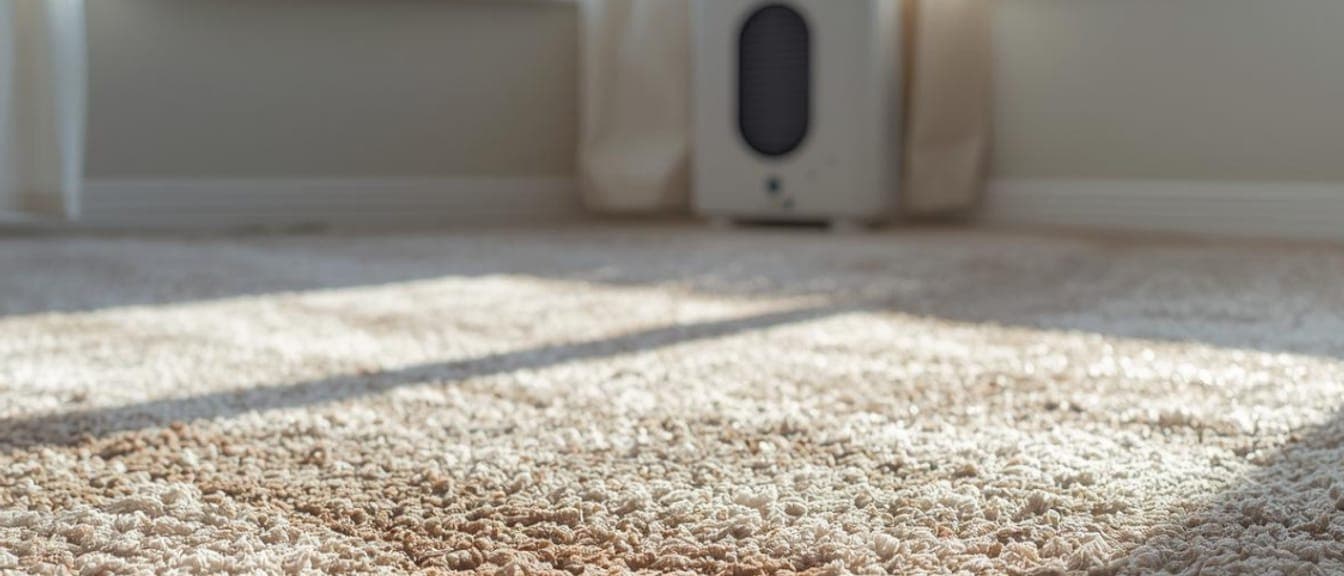
The fan plan has a lot going for it. Fans are already in the house, they cost pennies to run, and a carpet with air blasting across it feels like a problem being handled. Within a day the pile feels dry to the touch, which reads as proof. Then a week later the room smells like a gym bag, and the fan owner is on the phone with us asking how that is possible when the carpet has been dry for days.
What the carpet has actually been is dry on top. The gap between dry and dry on top is the whole subject of this post, and it comes down to three pieces of physics that the fan plan ignores.
A fan only works where the air can touch
Evaporation happens at a surface. Water molecules at the boundary between wet material and air pick up enough energy to leave, and a thin blanket of humid air forms right at that boundary. Left alone, that humid blanket slows everything down, because water evaporates reluctantly into air that is already damp. What a fan does, and does genuinely well, is sweep that blanket away and replace it with drier air, over and over. This is why the carpet pile, the layer the airflow actually touches, dries fast under a fan.
Notice what that description requires: contact. A fan can only accelerate evaporation from surfaces the moving air reaches. Carpet pile qualifies. Almost nothing underneath it does.
The room fills up
The second problem is where the water goes, which is nowhere. A fan just relocates moisture from the carpet into the room’s air, and air has a hard ceiling on how much water it can hold. In a closed bedroom with a soaked pad, that ceiling arrives fast. Humidity climbs toward saturation, the gap between wet material and damp air shrinks, and evaporation slows to a crawl. Run long enough, a fan in a sealed wet room is just a device for stirring humid air in circles.
You have felt this version of a room: windows fogged, everything faintly clammy, a smell that is not quite mildew yet. That is a room at equilibrium. Nothing in it is drying anymore, no matter how many fans are running, because the air has nothing left to give. The missing half of the drying equation is dehumidification, a machine that pulls water out of the air and hauls it away as liquid, keeping the air thirsty so the wet material has somewhere to send its moisture. Fans move the water to the air. Dehumidifiers get it out of the building. Skipping the second half is the single most common DIY drying mistake we see, and the little closet-sized cube unit most households own is built for damp air, so a genuinely flooded room outruns it within hours.
The pad is sealed inside a sandwich
Here is the part that decides most outcomes. Under the pile sits the carpet backing, two woven layers bonded with latex, which behaves like a plastic sheet once the pile above it is dry. Under the pad sits the subfloor, wood or concrete, which passes vapor slowly or not at all. The pad, the one layer built like a sponge and holding most of the spill, is sandwiched between those two vapor barriers. The hurricane of air moving through the room never touches it.
Open-cell foam pad holds many times its weight in water and gives it up grudgingly even in good conditions. Sealed under a dry-feeling carpet, it can stay wet for a week or more, quietly feeding moisture to the backing above and the subfloor below the entire time. The full anatomy of that failure is on our wet carpet pad page, but the short version is that the pad does not care how the pile feels.
The dry-feeling-pile trap
Put those three facts together and you get the trap that catches almost everyone. The fan dries the layer you can touch. Your hand reports dry. The fans get put away, the furniture goes back, and the sandwich underneath keeps its moisture for days, which is exactly the window where microbial growth gets started and backing adhesive lets go. The musty smell that shows up the following week is not bad luck. It is the pad filing its report.
A hand is the wrong instrument here. Dry is a number on a moisture meter, and a floor is done when its number stops arguing with the rest of the house, whatever the pile feels like.
What extraction-grade drying does differently
Start with the arithmetic. Water that leaves as liquid never has to evaporate at all, so professional drying begins with high-volume extraction, including slow, weighted passes that pull water up out of the pad through the carpet. That single step removes more water in an hour than fans move in a day.
Then the equipment finishes what extraction started: air movers set low and angled to keep air scrubbing across the wet surfaces, and dehumidifiers sized to the actual room, pulling that moisture out of the air continuously so evaporation never stalls. The dry-down gets checked with meters, and most rooms finish in one to three days instead of the week or more they would take on their own. The longer mechanics are on our wet carpet drying page.
Two honest boundaries. If what hit the floor was a dropped mop bucket on sheet vinyl or a coffee spill on carpet, towels and a fan are a perfectly good plan and you do not need us. And if the carpet has already been wet for several days, or the water came from a drain, a toilet, or outside, the job has moved past fans and past us both, into full-scale restoration territory, and we will say so on the phone. For everything between those lines, the sooner the extraction happens, the less there is to argue with. Your nearest crew is on our locations page, or call 1-800-SAFE-DRY.