
What Water Actually Does to Carpet
The pile you walk on is the last layer to suffer and the first to look fine again. Everything that decides whether the carpet survives happens underneath it.
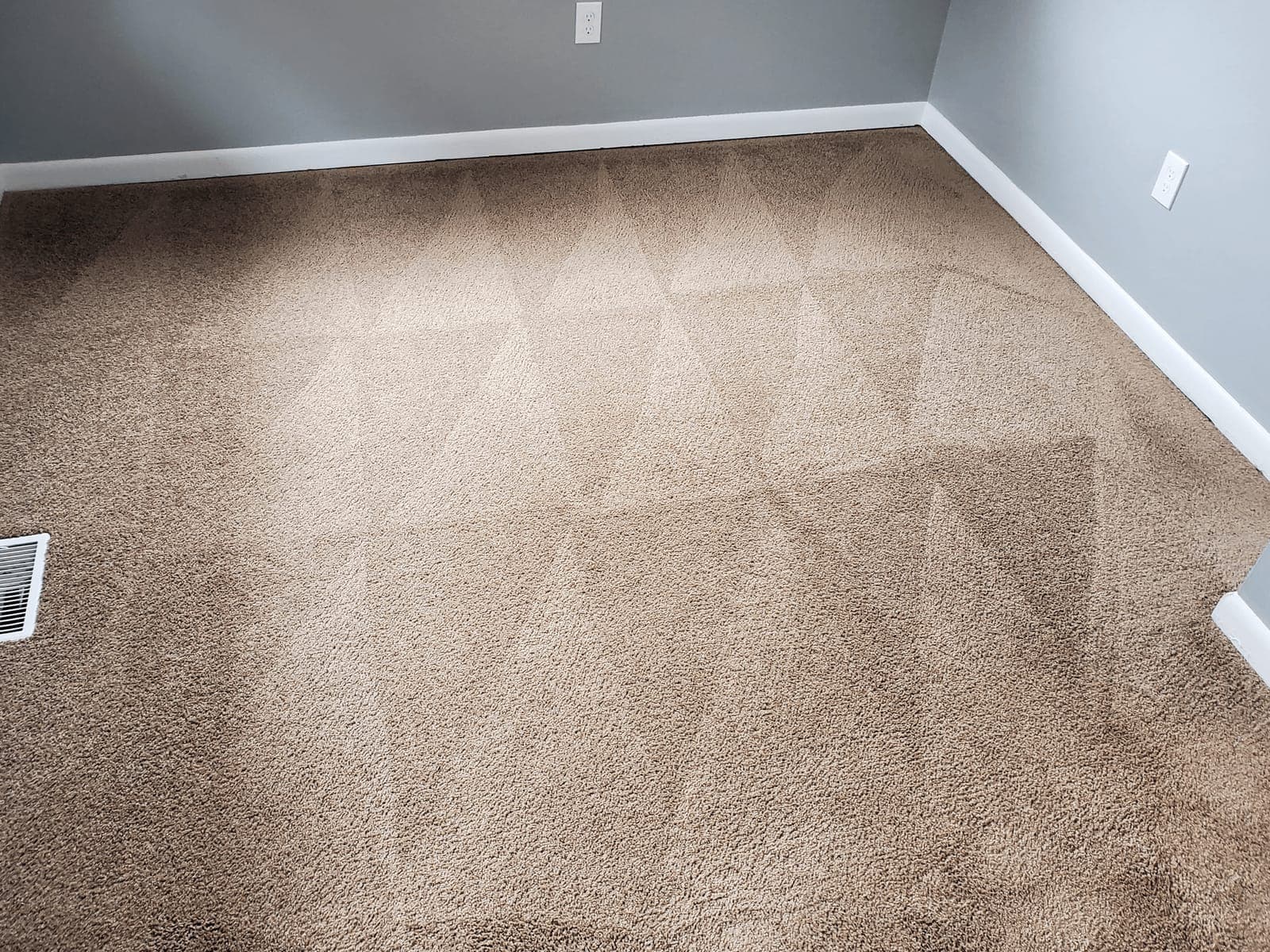
Carpet water damage cleanup is mostly a fight against the calendar. Carpet looks like one material, but it is a stack of four, and each layer in the stack fails on its own schedule, some in hours, some in days. This page walks through that stack from the fibers you can see down to the subfloor you cannot, so you know what the clock is doing while you decide who to call.
Drying the layer you can touch
The standard home response to wet carpet is towels, a box fan, and patience, and it produces a very convincing failure. Carpet pile is designed to release moisture quickly, so by the next morning the surface feels dry and everyone relaxes. Meanwhile the pad below is still holding most of the spill, sealed under a layer of carpet backing that blocks airflow almost as well as it blocks dirt. The fan dried the half inch you can reach. The gallons are in the half inch you cannot.
The other reflex is force: pulling the carpet back yourself to get at the pad, or scrubbing hard with a rented machine. Wet carpet is structurally weak carpet. The latex holding the backing together softens when it is saturated, so a hard tug at a corner can separate layers or pop a seam that was fine an hour earlier. A rented extractor recovers some surface water, which is worth something, but the aggressive wand work people do to compensate for its weak vacuum stresses exactly the adhesive layer that is most fragile right now.
The pile dries first and takes all the credit. The pad decides the outcome.
Four layers, one clock
Start at the top. The pile, the face fiber you see and vacuum, is usually nylon or polyester, and neither absorbs much water. That sounds like good news, and in a narrow way it is: pile almost always survives a clean-water event. What the fibers actually do is wick, passing water straight down and sideways, which is why a two-foot spill becomes a six-foot wet spot. The pile is the least vulnerable layer in the stack and the only one you can inspect from a standing position.
Below the pile sits the backing: two woven layers laminated together with latex adhesive. This is the layer with a deadline. Latex tolerates getting wet; it does not tolerate staying wet. Keep it saturated for a couple of days and the adhesive begins to let go, and the carpet delaminates into two sheets that used to be one. Delamination is permanent. No amount of drying reattaches a backing that has released, and a delaminated carpet ripples, bunches, and never lies flat again.
Under the backing is the pad, and the pad is where the water goes to live. Rebond foam pad is open-cell by design, built to compress and recover, which also makes it capable of holding several times its own weight in water. It sits in the dark with the carpet above it and the subfloor below it, and it gives that water back slowly, re-wetting the backing from below for days. Most of the smell, most of the delamination, and most of the lost carpets trace back to a pad nobody dried.
The subfloor is the last stop and the slowest to react. Plywood and OSB absorb over days, and once they swell, the trouble stops being a carpet problem. The whole stack runs on one rough timeline: in the first hours, everything is recoverable with real extraction. By the end of day one, the pad is the open question. Past day two or three, the latex is letting go, the subfloor is drinking, and the conversation shifts from drying to replacing, which is a conversation we will have with you honestly, because replacement is a job for a flooring installer, and we are not one.
How a wet carpet becomes a dry, clean one
Extraction first, and on carpet it is slow on purpose. Fast wand passes skim the pile. Weighted, repeated passes give the vacuum time to pull water up out of the pad, through the backing, through the pile, which is the only nondestructive route out of the assembly. The difference between a skim and a real extraction is most of the water, and every pass is aimed at the pad, because the pad is where the outcome gets decided.
Then the dry-down: air movers driving airflow across the carpet, dehumidification pulling the released moisture out of the room so the air can keep accepting more. A carpet assembly dried this way finishes in a few days, not a few weeks, and it gets called dry by meter reading against unaffected carpet elsewhere in the house, never by how the pile feels to a hand.
Dry is the middle of the job, not the end of it. Water carries whatever it crossed on the way in, and it leaves that behind as it evaporates. That deposit is what the cleaning removes: with the assembly reading dry, the carpet gets cleaned the way Safe-Dry cleans every carpet, carbonation instead of soap, barely any added moisture, and then everywhere the water reached gets sanitized. What comes back is a carpet that is dry, clean, and treated, on a pad and subfloor that were dried with it. And if the estimate turns up a pad or a backing past saving, that goes on the table first, with a fixed price attached only to the part of the job actually worth doing.
We walk through the full extract-dry-clean-sanitize sequence on our how water extraction works page, and every job is backed by our 100% satisfaction guarantee.
What to do before the crew arrives
The first minutes belong to you, and they matter. Here is the honest version of what actually helps, and the point where waiting for equipment beats improvising.
- 1
Stop the source before you fight the symptom
Close the supply valve, shut off the appliance, or close the main if you have to. Every minute of inflow adds to the pad's inventory, and the pad is the layer you least want stocked.
- 2
Get everything off the wet carpet
Furniture legs go up on blocks or foil, rugs and floor cushions come off entirely. Wood stain and rug dye both transfer into wet carpet within hours, and those marks survive the dry-down even when the water damage itself would not have.
- 3
Pull what you can from the surface
Towels under foot pressure, or a wet-dry vacuum moved slowly, recover real water in the first hour. Work from the edges of the wet area toward the middle so you are not spreading it into dry carpet.
- 4
Keep air moving, and keep your skepticism
A fan across the carpet helps at the margins and costs nothing. Just do not let a dry-feeling surface end the effort. The pad under it has its own schedule, and it does not report to your hand.
Frequently asked questions
How long before wet carpet is ruined?
There is no single hour, but there are stages. In the first few hours, a clean-water spill with real extraction is very recoverable. By the end of the first day, the pad becomes the question mark. Past two or three days of staying wet, the latex in the backing starts releasing and delamination begins, and that part is permanent. Same-day response exists because of this schedule.
Can water-damaged carpet be saved?
Often, if three things line up: the water was clean, the response was fast, and the backing has not delaminated. When those hold, extraction and a proper dry-down return a carpet you would not know had been wet. When they do not, we tell you at the walkthrough, because drying a carpet that is already coming apart wastes your money and our equipment time.
Do you replace carpet or pad if it cannot be saved?
No. We extract, dry, clean, and sanitize. We do not sell or install carpet, pad, or any other material, which is exactly why you can trust the answer when we say yours is saveable. There is no replacement job waiting for us on the other side of a no.
What does carpet water damage cleanup cost?
The honest answer is a number we can only get by walking the floor. Water travels farther than it shows, so the wet area is always bigger than the stain suggests. We meter it in person, mark where the moisture really stops, and put a fixed price on paper before any work begins. Never over the phone; a phone cannot read moisture.
Related water problems we handle
Wet carpet pad
The pad decides whether wet carpet is a save or a loss, and we tell you which one you have at the walkthrough.
Extraction & DryingSave or replace?
Three tests, run before anyone quotes anything, tell you whether the carpet is a drying job or a replacement.
Extraction & DryingWet carpet drying
Fans dry the pile and call it done. We dry the pad, the backing, and the floor under both.
Every hour it sits, it soaks deeper
Enter your zip code to reach your local Safe-Dry® team. Water extraction and drying for floors and carpet across 532 locations in 6 states, with same-day response in most areas.